
Corporate
Americas
United States & Canada
México
America Latina
Brasil
Oceania
Australia
New Zealand
Europe
Asia
India
Indonesia
Malaysia
Philippines
Singapore
Thailand
Vietnam
日本
中国
대한민국
台湾
Other Countries

Automatic dispensing of GS1-recommended labels
Simply scan your existing barcodes
Challenges
Improper handling can increase manual workload and undermine traceability

GS1 recommended RFID label issuing system
Benefits
Simply scan the existing barcode
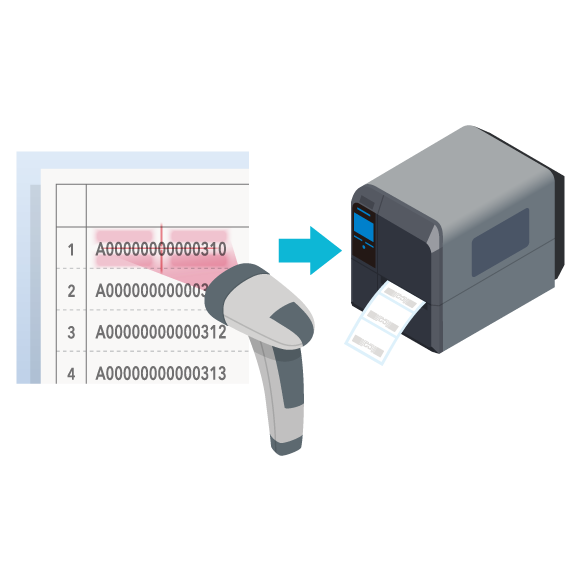
Barcode scanning → Automatic encoding → Label issuance
The GS1-128 barcode is scanned using a scanner, and the data is then encoded by the application. The label printer writes to the RFID tag and prints the label.
GS1-compliant labels can be printed without requiring the user to be aware of the encoding process. In addition, auto-numbering enables the assignment of serial numbers.
Streamline operations with RFID
The information written to the RFID tag is read by a handheld terminal or reader/writer, and the application performs the decoding process. The scanned data is displayed on a PC or tablet.
Since multiple RFID tags can be recognized in a single scan, there is no need to scan items one by one as with barcodes. This significantly reduces the time required for tasks such as inventory management and stocktaking.
Related Solutions


SATO support starts here
Need specifics on products or pricing?
Connect with our technical experts for fast, reliable support.