
West Coast Tomato is a highvolume tomato packer that sells produce to restaurants, grocery stores, repacking companies and other customers across the country. While the plant is capable of processing and packaging up to 1 million pounds of fruit in a single day, its labeling system had bogged down operations to the extent that management was ready to scrap the printers and start over.
Packaging labels play a key role in the supply chain. A well-designed label communicates important product information, helps manufacturers and shippers comply with government and industry regulations and standards, and (if barcodes are involved) acts as the cornerstone for automated tracking and shipping applications.
However, for a label to accomplish any of those tasks, it has to stay on the box. Just ask the staff at West Coast Tomato, a Palmetto, FL-based tomato packing company that solved its labeling problems with a redesigned print-andapply system, along with modifications to its material handling equipment. Under USDA requirements, produce companies have to properly label each box of their product. West Coast, however, was only achieving 50% label accuracy with its existing system.
"We had a very maintenance intensive system," says John Darling, systems manager at West Coast Tomato. "Our customers were complaining about the labels not being on the boxes, or falling off when they were delivered. We worked on that system for two or three years trying to get it to operate correctly, then we started looking for a replacement."
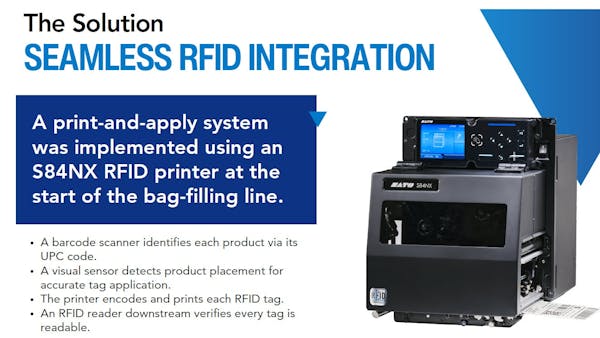
The plant operates 17 lines, each with its own print/apply station to label boxes. Two different automated fillers, each handling a different type of tomato, feed 25 pound boxes of fruit to each line. As those boxes merge, photoelectric eyes trigger the print/ apply system to produce the correct label (depending on which filler the box came from) and apply it as the box moves down the conveyor.
The system never worked correctly. Boxes were not only mislabeled, but the print/apply system was not able to effectively attach the labels. That meant that even if the labels made it on to the right boxes, they frequently fell off prior to shipment.
"The boxes weren't stopped at the applicator," says David Moore, maintenance manager at West Coast Tomato. "The labels would sort of get blown on the boxes, but they would just barely touch them."
An employee had to manually check each pallet and re-apply any missing labels, a time consuming process that led to even more errors. Employees also had to periodically scrape hundreds of stray labels off the plant floor.
The issues with the labeling system, combined with some conveyor problems, led to frequent jams and work stoppages, which negatively impacted the plant's processing throughput.