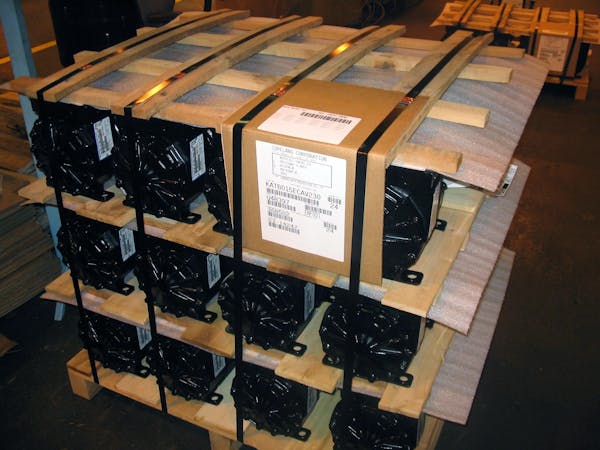
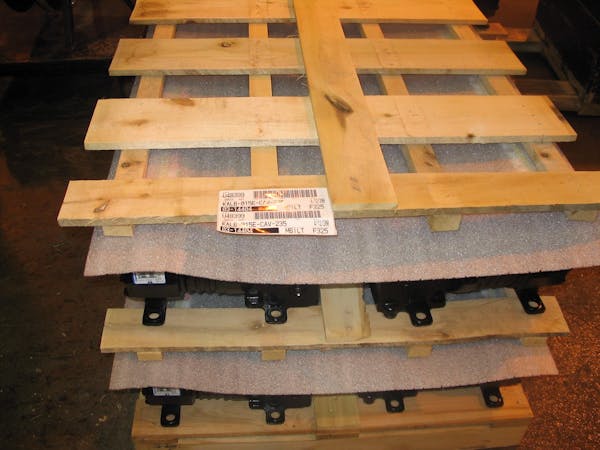
Many of Copeland's compressors look exactly the same and are packaged up to 40 on a skid. While the identical look is helpful in the manufacturing process, in packing it can be problematic. Compounding the possibility of misidentification is the 17-digit model number, which can be misread by workers.
The company's commitment to accuracy is strong, says George Dade, senior IT business analyst for Copeland Information Systems. "We use the Japanese term 'Poka,' meaning inadvertent mistake, and 'Yoke,' meaning prevent, to describe the philosophy of mistake proofing that we utilize throughout our processes."
In the late nineties, Copeland felt it was important to reapply Poka Yoke to its packing department, and focused on its Hartselle, Alabama plant, its highestvolume facility.
Copeland wanted to find a technologybased solution that could quickly and easily check the packed orders to make sure they were 100 percent correct. The company formed a project team made up of Keith Estes, Hartselle's quality engineer; Dade and Randy Condon, both from Copeland Information Systems' MIS group; and Dave Slagle, Rob Bye and Jeff Gottschalk from The SMS Group, a systems integrator and long-time partner of Copeland also based in Sidney.
The team looked at the processes in question to make some critical choices. Of chief importance was to verify what was packed without slowing down the workers. "Our packing team only has a few seconds to select a compressor from the end of the conveyor, hoist it into the skid it belongs in, install the cardboard packaging items, apply shipping labels, move it to the shrink wrap machine, and then to the shipping department. The pace is fast, the compressors are heavy, and everyone knows that nothing can stop the line," says Dade.
The project they outlined had two phases. One converted Copeland's batch label printing system to an on-demand system to create "nameplate" labels for each compressor as it is picked. The other implemented the pack verification system using bar code scanning, label printing and software developed by The SMS Group. By printing nameplate labels only as needed, workers could pack skids more efficiently and not, for example, have two skids for the same model open at the same time.
When a compressor reaches the packing area, its work-in-process tracking label is scanned with a fixed-head scanner, which also queries the company's Scheduling/SQL Database to determine which customer gets the compressor. A nameplate label is created using SATO M84Pro thermal printers. The nameplate is placed on the compressor, and the operator scans that nameplate using an Intermec 2415 wireless hand-held unit to verify the unit is being packed in the right skid.
Phase two allows the packers to do their jobs with confidence, knowing every compressor they add to a skid is the right one. The SMS Group designed the Pack Verify System using its SMS CORE 2000 development system to connect its printers and hand-held scanners to Copeland's database using the 802.11b protocol and Intermec and Cisco equipment. The development system allows connection of a variety of devices from various manufacturers in endless combinations. For example, while upgrading to Intermec 2415s, Copeland continues to use its PSC/Percon Falcon hand-held units with no problems.
This part of the application begins with the Pack Line coordinator determining how many skids are needed to fill an order. The coordinator uses a SATO printer to create a skid license plate label from the company's VisualBasic program. The 4 by 4-inch label contains pertinent order information and a unique 13-character license serial number encoded in a Code 39 bar code. The label is placed on a board given to the packing team.