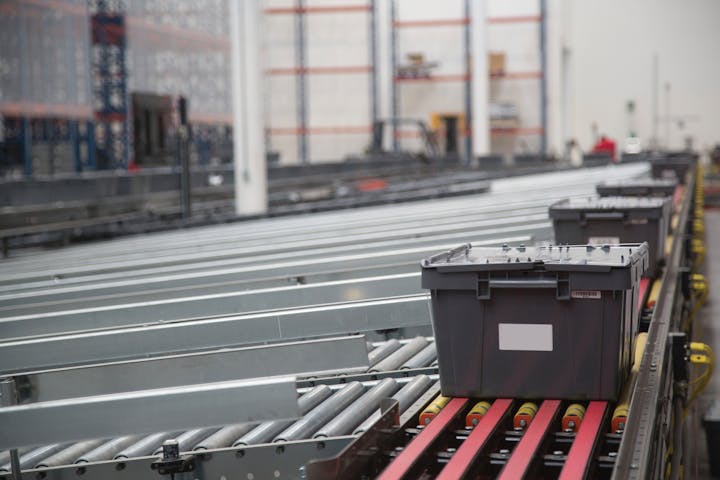
With that much volume and sales, the company opened its eighth distribution center in 2000, a state-ofthe-art, 875,000-sq-ft facility located in Lancaster, CA. Approximately 60 miles northeast of Los Angeles, the massive Lancaster DC fills about 12,000 to 25,000 bulk plastic totes each day with a wide assortment of "front-end" products before shipping them to 65 to 75 of the 400-plus stores within its distribution base. These items range from nonprescription health and beauty aids and cosmetics to small appliances. The outbound hand-held totes are clearly identified by a 20-digit, barcoded shipping label affixed to their lid.
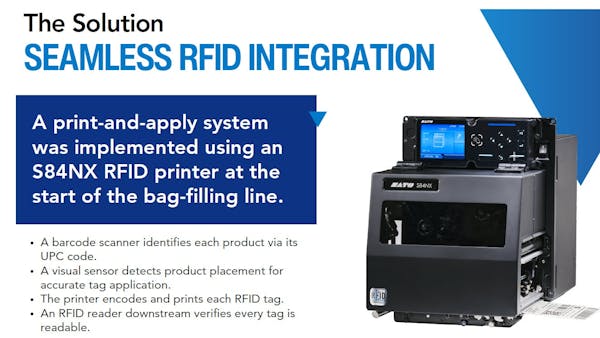
An extensive use of pick-to-light technology guides most of the DC's split-case items in the order-picking operation. This operation is equipped with about eight miles of conveyor leading to multiple pick modules, carousels, "fast-mover" lines and required reliable, durable bar-code labeling equipment that could upgrade Rite Aid's product identification, tracking, shipment addressing and barcoding processes. To accommodate its bar coding/labeling function, Rite Aid installed a dozen PA/5000 label printer/ applicators from Diagraph.
This next-label-out variable-information printer/applicator system generates assorted fonts, graphics and bar codes, printed and applied from pressuresensitive label rollstock at resolutions of 203 or 300 dpi and works with label sizes up to 7.2 x 13 in. Rite Aid's bar-coded labels measure 3 x 4 in. Consistently applying the p-s labels with accuracy and precision, each of the PA/5000s at Rite Aid's facility are integrated with SATO print engines that feature a tamp label applicator pad (the system is also available with a choice of wipe-on, blow-on, pallet-tamp, dualpanel wraparound or dual-panel/duallabel applicators). The Rite Aid machines have an output capacity of about 15 totes/min but are designed to reach speeds of up to 30 totes/min.
Outfitted with built-in diagnostics and a menu-driven interface, the PA/5000 is easy to operate, Rite Aid says, with a menu that indicates all of the machine parameters. The PA/5000's discrete input/outputs (I/O) were impressive to Rite Aid's Bill Atherton, senior engineer, supply chain, who spearheaded the equipment installations.
"We needed a print-and-apply system that could deliver highperformance labeling in a demanding industrial environment," he says. "The I/O capabilities of the Diagraph label printer/applicators were a big benefit, because they eliminated our having to get another type of controller just for the labeler. We wanted the machine to be able to take care of all error inputs and outputs. There were few label printer/applicators [on the market] that offered this kind of capability when we purchased these systems. They were clearly superior."
Atherton says that when all of the mezzanines are taken into account, there is probably more than a million sq ft of space at the Lancaster facility. "This is our newest facility, and it's equipped with all new machinery," he says. "We also installed miles of conveyor from Siemens Dematic to handle our high volumes at the stores out here."
That the PA/5000 had to be reliable was an understatement, emphasizes Jack McMahon, regional market director for Diagraph. "Given the throughput of their operation, it was critical that Rite Aid have a machine that could run up to seven days a week, twentyfour hours a day," he says. "Reliability was at the top of the page, along with the ability of the machine to provide enough inputs and outputs–things we customized for Rite Aid and subsequently built into our unit as standard features."
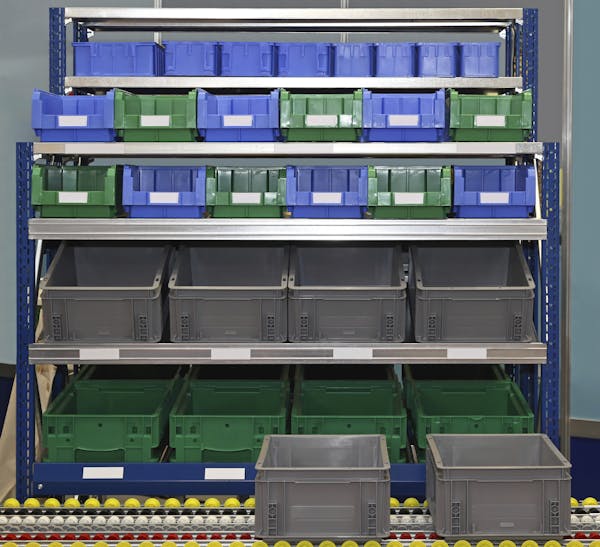
The DC is laid out in zones similar to the zones in the company's stores, which makes restocking the stores more efficient, PD is told. The DC's sophisticated warehouse-management system (WMS) includes pick modules for the many stockkeeping units. The picking operation includes "case-pick" modules from which full caseloads of products are picked, as well as "each-pick" modules or items picked from split cases for about 70 percent of the items shipped. Each module has two or three levels and, according to Atherton, is a large racking system, with access from two sides–the back for replenishment and the front for order picking.
On the order-picking side, interactive pick-to-light systems use lighted numbers under each item on a flow rack to indicate which items and how many should be picked from each product bay for each pick list. The picking operator removes the indicated number of items and pushes a button to confirm the items were picked. The process is integrated with the label applicators by a personal computer. Atherton says having label printer/applicators on the picking lines allows the order pickers to focus solely on filling the orders without having to carry and affix labels.