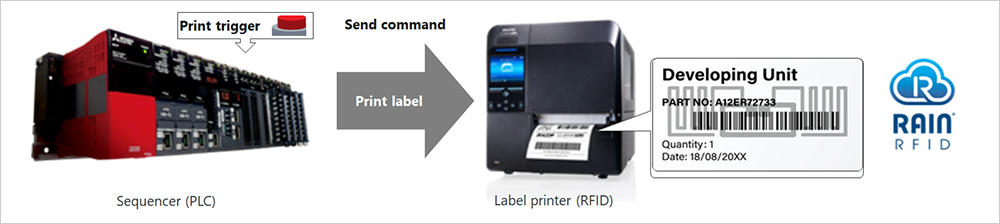
In order to reduce programming time, Mitsubishi Electric has also prepared a customizable sample code that enables the sequencers to communicate with SATO printers in typical factory labeling and RFID tagging scenarios, such as processing, assembly, inspection and shipping.
By enabling MELSEC sequencers with SATO barcode printer language (SBPL) commands, processes requiring labeling are more easily automated in various stages of production. Mitsubishi Electric has developed sample programs in English and Chinese, in addition to Japanese. The sample script can be customized for standard processes to greatly reduce the time required for programming.
In recent years, there has been a growing need for PC-less workflows in the factory. Contributing factors include the need to reduce manual input and the associated risk of errors. Other drivers include lack of space, IT security concerns and stability of operations. Without PCs in the mix, software license management is no longer a concern, which further automates the IT management aspect of production.
Meanwhile, manufacturers are constantly looking for ways to streamline and visualize operations. Adding industrial automation equipment can enable 24/7 operations with increased accuracy and improved scalability, making it easier for manufacturers to adapt to changes in production volume or expand operations when necessary.
“Together with Mitsubishi Electric, we want to help automate every process related to the production of parts and finished products in the factory,” commented Hayato Shindo, executive officer overseeing global business at SATO Holdings Corporation. “Manufacturers can turn to SATO for connected and flexible solutions that can be deployed with speed.”
The sample SBPL script for MELSEC controllers can be found in English, Chinese and Japanese here:
MELSEC iQ-R sample program for SATO CL4NX Plus
MELSEC iQ-F sample program for SATO CL4NX Plus