SATO Corporation, a market leader in next-generation auto-ID and labeling solutions, is conducting a trial that aims to minimize unsold foods by dynamically marking down foods based on expiry. The trial backed1 by the Japanese government is being conducted at the Maizuru Carrot supermarket in Karatsu, Saga Prefecture, from January 24 to February 26. This is the first trial in Japan to use 2D barcodes with GS1 standards at the point of sale.

Corporate
Americas
United States & Canada
México
America Latina
Brasil
Oceania
Australia
New Zealand
Europe
Asia
India
Indonesia
Malaysia
Philippines
Singapore
Thailand
Vietnam
日本
中国
대한민국
台湾
Other Countries
Feb 14, 2023
Press Releases
SATO and Partners Conduct Pilot of Item-level Tracking and Dynamic Pricing Using Expiry
2D barcode system has potential to streamline the food supply chain and cut waste
Overview of the trial
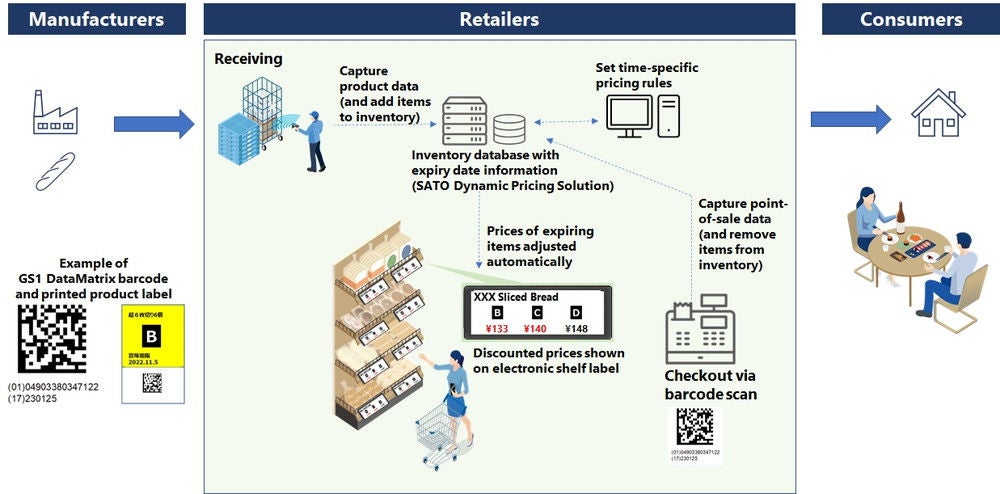
SATO is providing and operating the dynamic pricing system, as well as supplying the electronic shelf tags used in the trial. Using the trial outcomes, SATO and other participating organizations will develop solutions and commercialize them for retailers to achieve greater supply chain efficiency and further food waste reduction.
According to government data,2 food loss and waste in Japan in fiscal 2020 were approximately 5.22 million tons, of which over half (2.75 million tons) was generated by businesses in the food industry. Such inefficient use of food resources stresses the supply chain and leads to waste that has an impact on businesses’ bottom line due to disposal costs. It also produces a cascade of effects on the environment, which is a huge concern for businesses that are trying to make their operations more sustainable.
As food products can only be delivered or sold while they are fresh and safe, retailers need to manage inventory depending on the length of their shelf life if they want to streamline supply chain workflows and reduce unsold foods. Many are hopeful that using information technology to manage food products by their individual best-before or consume-by dates would allow them to order and control inventory more accurately. Technology-enabled dynamic pricing, for example, is being increasingly trialed and implemented in Japan and around the world as an effective way of helping businesses sell more and waste less.
Labels are printed with GS1 DataMatrix3 barcodes and applied to food products. Unlike traditional 1D barcodes, these dynamic 2D barcodes carry product information such as batch, lot number, and expiry dates, in addition to product identification. When this data is captured into the SATO Dynamic Pricing Solution4 during the receiving process in-store and integrated as point-of-sale (POS) sales data, retailers can track each item by SKU (stock keeping unit) and expiry date to not only set rules for repricing items automatically with changes in stock levels at specific times of the day but also differentiate pricing of items with the same SKU based on their respective shelf life.
The discount pricing is integrated with electronic shelf labels and POS systems so that consumers can see the price options to choose the item that best fits their needs and pay for it by getting its barcoded label scanned at checkout.
Scope of the trial
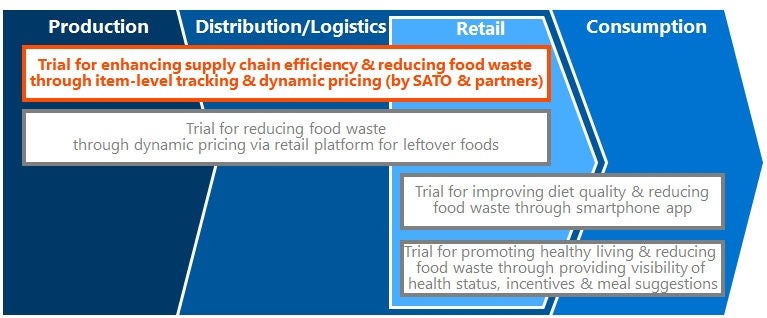
The objective of this trial is to demonstrate how tracking and dynamically marking down products using expiry data can generate efficiencies and food waste reduction:
- Reduce workloads
The trial will confirm how much labor savings stores can realize through eliminating the need to physically change price tags or apply discount stickers. - Optimize turnover
The trial verifies whether stores can promote perishable foods effectively and efficiently through a system that applies tiered pricing with gradual adjustment in discount rates (instead of a one-time large discount) to encourage consumers to choose items with a shorter expiry date for a lower price. - Explore the change in consumer behavior
Most consumers look for markdown labels offering the best deal, and most likely, three out of four consumers will take the fresher product if the price is same.5 By implementing the new digital pricing solution, we will explore changes in consumer behavior as well as consumer satisfaction on the best deals.
The pilot trial was conducted in collaboration with the Japan Research Institute, Imamura Trading, West Japan Ishida and Maizuru Carrot supermarket, with the assistance of GS1 Japan and SES-imagotag (Japan).
1. This trial is part of the FY 2022 project by Japan’s Ministry of Economy, Trade and Industry (METI) for establishing infrastructures to enhance distribution efficiency and create added value. METI has commissioned the project to the Japan Research Institute, which conducts proof-of-concept trials with food producers/manufacturers and retailers and with the support of business partners to explore the role of IoT technologies in enhancing supply chain efficiency and reducing food waste.
2. Source: Press release by Japan’s Ministry of the Environment (June 9, 2022)
3. A variant of the 2D DataMatrix barcode that encodes data using GS1 Application Identifiers. Some countries are already transitioning to this globally standardized symbology as a new way of labeling medical and other products.
4. A dynamic pricing solution that combines GS1 DataMatrix barcodes, encoded expiry data, manufacturer-applied group tags and electronic shelf labels. With the gathering of big data, the solution can be further enhanced to automate repricing using AI.
5. Source: 2022 PoC with Ito Yokado, also a METI project.